
Quebec Selected Skilled Workers

Caregivers
What is Express Entry.
The government of Canada (IRCC) has commenced an online system in order to:
- Create a pool of competing prospective permanent residence applicants;
- Choose the most qualified applicants who best meet the Canadian job market demand, and;
- Expedite the selection process;
The government will send out Invitations to Apply (ITA) to prospective applicants selected via periodic draws.
The Express Entry System encompasses three main federal programs:
- Federal Skilled Worker (FSW);
- Federal Skilled Trades (FST);
- Canadian Experience Class (CES).
Selection Factors
The prospective applicants will be scored and ranked based on selection factors including, but not limited to the following:
- Age;
- Spousal points, if applicable;
- Level of Education – Canadian and/or foreign Education;
- English and/or French proficiency;
- Work Experience (Foreign and/or Canadian) check your NOC here;
- Adaptability points;
- Arranged employment.
How to increase your score?
- Retake the language tests increase your CLB level;
- Gain more experience;
- Obtain another certificate/ diploma and degree;
- We can help you throughout admission and study permit application to obtain a Canadian certificate/ diploma/ degree;
- Then, you can apply post-graduate work permit (PGWP) and gain Canadian work experience, if meeting the requirements, to be eligible for Canadian Experience Class;
- Provided that all the IRCC stipulated requirements are met (Contact us).
- Find a job and get a job offer;
- Get Provincial Nomination;
- Spouse/ common-law Partner
- Encourage your spouse/ common-law partner to increase their scores, if married. For example, by (re)taking a language test, learning and
- might want to consider applying as a single applicant while declaring your spouse or common-law partner as a non-accompanying one. Subsequently, sponsoring them, if you get a PR;
- See who is a stronger applicant, the stronger applicant should be the principal applicant;
- if you are both have strong profiles, we can create two separate EE profiles for both of you to increase your chances;
Disclaimer: The following is only the glimpse of the programs for acquaintance, Quebec province requirements are different. Please contact us for a thorough evaluation of your case.
Who can sponsor
Usually, spouses/ partners and dependent children, parents and grandparents and in some cases some other relative may be sponsored by:
- Canadian citizen or
- person registered in Canada as an Indian under the Canadian Indian Act or
- permanent resident of Canada
provided that the sponsors and the sponsored relatives meet each category’s qualifications and requirements;
The Canadian Sponsorship Programs fall into the following categories:
Sponsor your Spouse/ Partner or Dependent Children
You can sponsor your spouse/ partner or dependent children to become a permanent resident of Canada, if you are eligible and if you:
- support them financially;
- make sure they don’t need social assistance from the government;
Some minimum eligibility requirements to Sponsor
- you are at least 18 years old;
- you are Canadian citizen or person registered in Canada as an Indian under the Canadian Indian Act or permanent resident of Canada;
- You are financially capable to financially support the sponsored person(s) for the stipulated period of time;
- You’re not receiving social assistance for reasons other than a disability;
- You must meet specific Quebec requirements, if you live in Quebec.
Income requirement
You do not have to prove your minimum income if you are sponsoring you spouse or partner or dependent child unless:
- you’re sponsoring a dependent child that has 1 or more dependent children of their own, or
- you’re sponsoring a spouse or partner that has a dependent child, and their dependent child has 1 or more children of their own.
Who can you sponsor?
Your Spouse
MUST be:
- legally married to you;
- at least 18 years old.
Your common-law partner
- isn’t legally married to you;
- can be either sex;
- is at least 18 years old
- has been living with you for at least 12 consecutive months, meaning you’ve been living together continuously for 1 year in a conjugal relationship, without any long periods apart
- Any time spent away from each other should have been
- Short
- Temporary
- Any time spent away from each other should have been
You need to provide proof of your common-law relationship.
Your conjugal partner
- isn’t legally married to you or in a common-law relationship with you;
- can be either sex;
- is at least 18 years old;
- has been in a relationship with you for at least 1 year;
- lives outside Canada;
- can’t live with you in their country of residence or marry you because of significant legal and immigration reasons such as:
- their marital status (for example, they’re still married to someone else in a country where divorce isn’t possible);
- their sexual orientation (for example, you are in a same-sex relationship, and same-sex relationships are not accepted, or same-sex marriage is illegal where they live),;
- persecution (for example, your relationship is between different religious groups which is not accepted and they may be punished legally or socially)
You’ll need to give proof that you could not live together or get married in your conjugal partner’s country (for example, proof of refused long-term stays in each other’s country).
Dependent children
Dependent MUST be:
- under 22 years old;
- do not have spouse or common-law partner;
- except for cases older than 22 years who are:
- unable to financially support themselves due to mental and/or physical condition(s), and;
- financially depend on their parents since before the age of 22 till the immigration processing is complete.
- except for cases older than 22 years who are:
Your own dependent child, Your spouse or partner and their dependent child and their dependent children
So long as they meet the requirements of a dependent child.
They should provide:
N.B.: you cannot sponsor an inadmissible person to Canada.
Sponsor your Adopted Child
This are two different processes to follow and qualify to sponsor your adopted child:
- The application for Sponsorship, and;
- The application for permanent residence for the Child.
Please contact us.
Parents and Grandparents Sponsorship (PGP)
You can apply to sponsor your parents and grandparents if;
- You must have first submitted your interest, and;
- You have been sent the invitation to apply by IRCC;
- You are at least 18 years old;
- You are a Canadian citizen, a permanent resident of Canada, or a person registered in Canada as an Indian under the Canadian Indian Act.
- You and your spouse / common-law partner, as your co-signer, if applicable, meet the minimum financial/ income requirements to be eligible to sponsor your parents and grandparents;
Sponsor your Relatives
Sponsoring a relative is applicable only in very specific situations. We recommend you to connect with us to seek professional opinion before taking any actions.
There are two different options under this category:
Sponsor your orphaned brother, sister, nephew, niece or grandchild
If an orphaned brother, sister, nephew, niece or grandchild meets all the following conditions, you may be eligible to sponsor them:
- they’re related to you by blood or adoption
- both their mother and father passed away
- they’re under 18 years of age
- they’re single (not married or in a common-law or conjugal relationship)
You can’t sponsor your brother, sister, nephew, niece or grandchild if:
- one of their parents is still alive
- no one knows where their parents are
- their parents abandoned them
- someone else other than their parents is taking care of them while one or both their parents are alive
- their parent is in jail or otherwise detained
Other relatives
If you meet all of the following conditions, you may be eligible to sponsor one relative (any age).
- you (the person who wants to sponsor your relative) don’thave a living relative you could sponsor instead, such as a:
- spouse
- common-law partner
- conjugal partner
- son or daughter
- parent
- grandparent
- orphaned brother or sister
- orphaned nephew or niece
- orphaned grandchild
- you (the potential sponsor) don’t have any relatives (aunt or uncle or any of the relatives listed above), who is a:
- Canadian citizen
- permanent resident
- registered Indian under the Indian Act
Don’t forget to include the sponsored person’s spouse, partner, or dependent children who will come with them to Canada in the same sponsorship application.
Who can’t sponsor a relative
You may NOT be eligible to sponsor a relative if you:
- are in prison
- have not paid your alimony or child support payments
- have declared bankruptcy and haven’t been released from it yet
- got social assistance for reasons other than being disabled
- didn’t pay back an immigration loan, made late payments or missed payments
- sponsored another relative in the past and didn’t meet the terms of the sponsorship agreement were convicted of a violent crime, any offence against a relative or any sexual offence, depending on details of the case, such as:
- the type of offence
- how long ago it was
- whether a record suspension was issued (formerly called “pardons” in Canada)
Other things not on this list may stop you from being able to sponsor a relative.
The minimum income requirements to be eligible for sponsorship is LICO plus 30% for the three tax year before the day you apply, except for 2020 tax year, which is still at LICO level instead of minimum necessary income plus 30% due to pandemic financial impacts.
| Total number of people you’ll be responsible for | 2020 | 2019 | 2018 |
|---|---|---|---|
|
2 people |
$32,270 |
$41,007 |
$40,379 |
|
3 people |
$39,672 |
$50,414 |
$49,641 |
|
4 people |
$48,167 |
$61,209 |
$60,271 |
|
5 people |
$54,630 |
$69,423 |
$68,358 |
|
6 people |
$61,613 |
$78,296 |
$77,095 |
|
7 people |
$68,598 |
$87,172 |
$85,835 |
|
If more than 7 people, for each additional person, add: |
$6,985 |
$8,876 |
$8,740 |
You can include the following benefits in your household income calculation for 2020 tax year:
- regular Employment Insurance benefits (rather than just special Employment Insurance benefits)
- any Canada Emergency Response Benefits issued under the
- Employment Insurance Act or
- Canadian Emergency Response Benefit Act
- other temporary COVID-19 related benefits
- as long as they’re not part of provincial social assistance programs
| Person you sponsor | Length of undertaking for all provinces except Quebec |
|---|---|
|
Spouse, common-law partner or conjugal partner |
3 years |
|
Dependent child (biological or adopted) or child to be adopted in Canada under 22 years of age |
10 years, or until age 25, whichever comes first |
|
Dependent child 22 years of age or older |
3 years |
|
Parent or grandparent |
20 years |
|
Other relative |
10 years |
Notes:
- your undertaking starts on the day the sponsored person becomes PR;
- you are still financially responsible for the foregoing period, even if;
- your relationship with the sponsored person changes,
- the sponsored person becomes a Canadian citizen;
- your financial situation changes;
- you want to withdraw your sponsorship after the sponsored person becomes permanent resident.
If you are skilled foreign worker or an international graduate who think of a pathway to permeant residence in Canada/ Atlantic provinces, this might be a good program to consider.
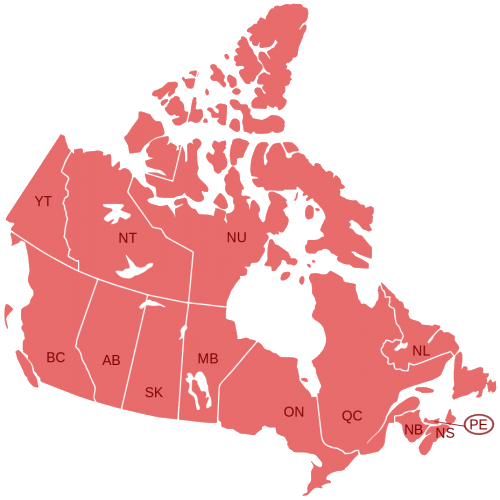
This program encompasses 4 Atlantic provinces of Canada:
- Newfoundland and Labrador;
- Prince Edward Island;
- Nova Scotia, and;
- New Brunswick.
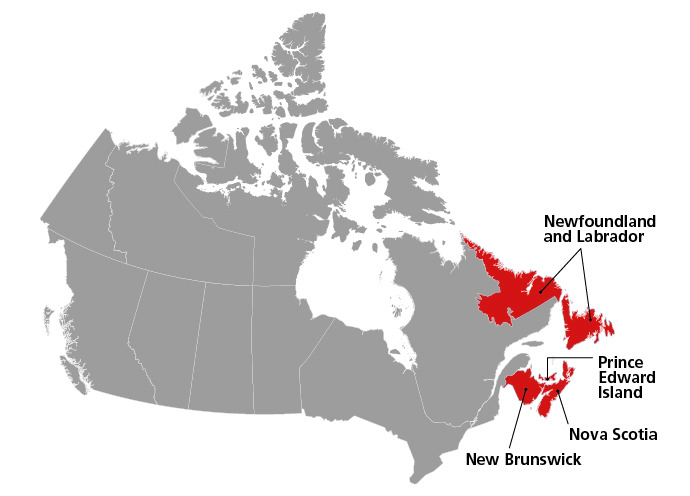
This program is mainly focused to meet the local job demand and requirements of the Atlantic provinces.
Mandatory Requirements to Participate in this Program
you must be either a recent graduate of a recognized post-secondary institution in Atlantic Canada, or a skilled worker who has received a job offer from a designated employer from one of the four Atlantic provinces to be able to participate in this program.
Some of the preliminary requirements;
- You must be either
- A foreign skilled worker with qualifying work experience, or;
- An international graduate of a recognized post-secondary institution in Atlantic Canada;
- Educational requirements;
- Language requirements;
Proof of settlement fund and/or valid work permit, if you are already in Canada
| NOC level job offer | Work experience requirement |
|---|---|
|
Noc 0 |
NOC 0, A, B, C |
|
Noc A |
NOC A, B, C |
|
Noc B |
NOC B, C |
|
Noc C |
NOC C |
Atlantic Program Work Permit
Can I apply for a work permit while I am waiting for my application to be process?
You may be eligible to apply for a work permit, while your PR application is in process provided that you meet all the program’s PR application requirements.
The PR application must be submitted within 90 days as of the date of your work permit application submittal.
Specification of Atlantic Program work permit
Please note that this work permit:
- Is only for this program;
- Is valid only for one year;
- Is an employer-specific work permit i.e. you must only work for the employer who offered you the job.
Contact us for consultation to see if you and/or your job offer/ employer meet the minimum requirements and you are eligible for this program


 Contact us